Speaking of Art with Mike Carroll
By M.Sebastian Araujo
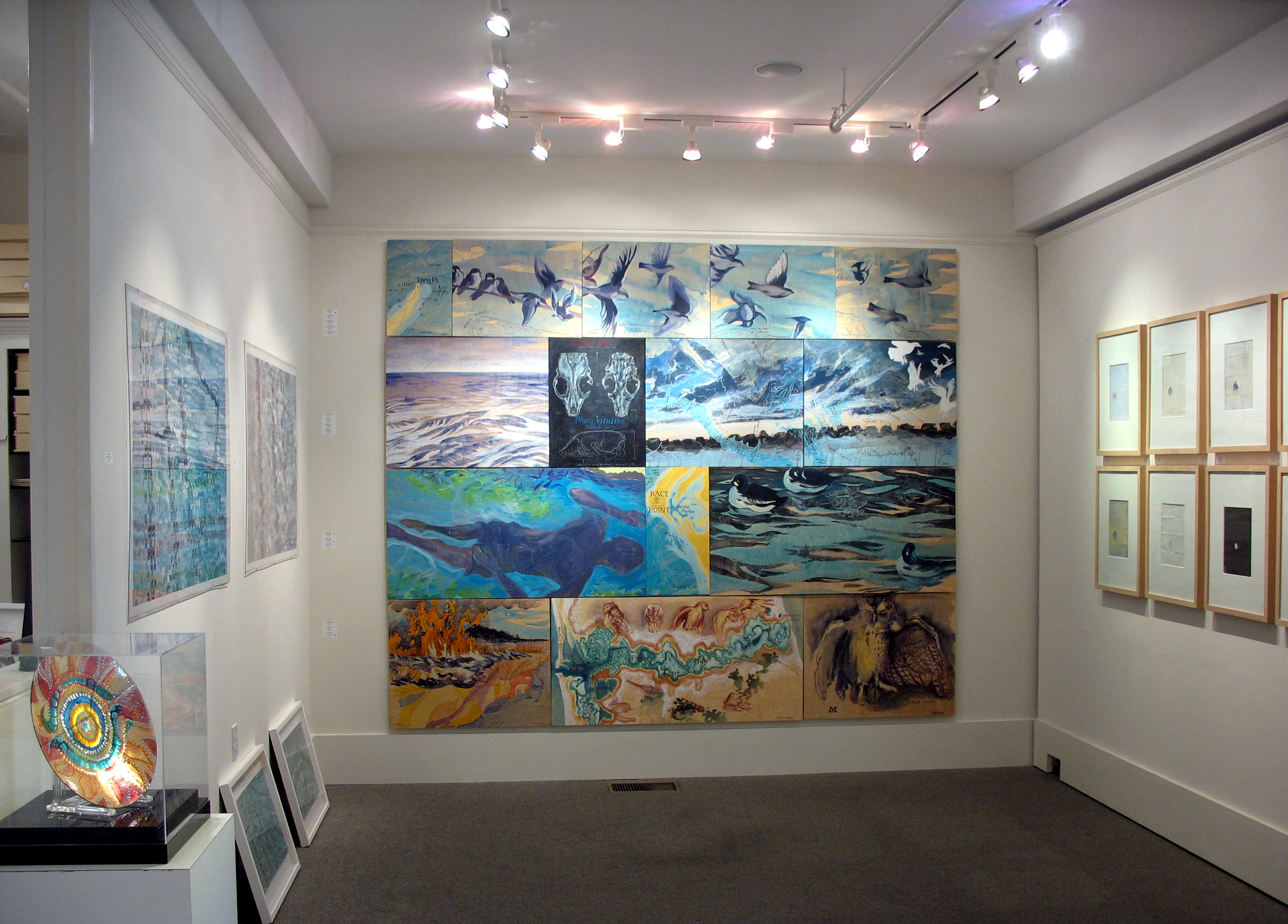
In 1998 Mike Carroll opened his gallery in an old school house in the East End of town….taking the Ptown Art scene to a new level.
It always amazes me to walk thru those doors …presentation, ART and the entire vibe of the place is truly unique and very conducive to not just buying Art but also appreciating and really getting a sense of the creative process. It is with his Artist’s Eye that the shows are curated and always uniquely presented. Recently as the pace slowed down a notch we had a chat about just what makes this Artist and Gallery Owner do what he does SO superbly!

What in the Crazy World around us affects what you do?
Everything, and at times some things more than others. When people, ideas and sometimes material things take hold in our mind’s eye and capture people’s interest they can approach or contribute to some forward motion or critical mass. This helps popular notions, memes, schools of thought, movements, and coincidences happen. Also celebrity and commercial successes.
So one strong influence on art is context and another is whether the (artist’s) studio is isolated (maybe rural) or urban. Nature or architecture, right? There’s the work that addresses mass, volume, scale, and impact that’s likely meant to be viewed by a lots of people: municipal or public looking, and then there’s the more personal kind of thing. Maybe this personal version of looking comes from a relationship with nature or the landscape or the elements so the idea is that a relationship can be established between an individual viewer and the image or idea. This is often a bodied notion and occurs in space and time. There’s also work that uses language or is about language or being part of a dialogue. This includes things that feel like commentary, things that take a previous idea or notion a step further, and also art that talks about what language is or can do, like artwork that’s about currency or information or the ways that things are transferred or understood. There’s so much and so much more too.
What changes do you see in the Ptown ART scene today…?
The main change is that we’re no longer an island. Technology has made a bridge for us and media has popularized the town’s refugee status, so we are no longer as far away as we were. We have to concentrate more if we are to develop separate ideas and social orders. Plus our larger society is more mainstreamed than in the past so we see the eccentricities that people love about outliers being medicated, our behaviors pathologized, our art making seen as a business opportunity and acquisition a means to safety. So the people who speak to these circumstances from the outside or from separate societies within the society as a whole are figuring out how to come out from having become ‘embedded’ for about the last 25-30 years during which we were presented with the notion that artists could succeed in a capitalist mainstream. The particular challenge from Provincetown is the economy and how the people who make things can find a way to stay in a place with small work spaces, a spare studio-to-studio dialogue, and the need to find a workable value system that can respond to the greater shifts in art making in the rest of the world in a meaningful way.
That said, I have come to see Provincetown as a rambling, periodic re-gathering of events, languages, makings, chosen families and chances taken. I spent many early years here concerned with being part of the town, to understand where the center of things are and what makes the place happen; to belong. My particular experience in the gallery world has changed that. I think Provincetown is endlessly wonderful but also functions a bit like a cruel mother; one that accepts everything while retaining very little. It is transient and people appear here in chapters. The extreme seasons are a fabulous re-set button but can also erase histories. For these reasons I think historians and journalists like yourself are vital, but also that at the end of the day the Provincetown you have is the one you make – the culture that one makes from the ground on which they stand. This is what we have and this is our town. Objects resonate and relay our stories and can bear witness to our history. But I think it is possible to become confused and lost unless you make something. It’s not a place for consumers to live, despite the party vibe. But when you’re putting on the play you’re not usually the audience too so that can create conflict for people.


What in Your Life inspires your work?
I get super cranky when I don’t make art, and that is impolite. I also have a screw loose, I think.
Somewhere in me there is this notion that I’d rather leave behind a descent piece of art than almost anything else. So it’s a little selfish, but you know I was raised through the narcissism of the 70’s and that’s a filter for me still. The challenge from that position is to find a good place or good self inside me from which to be operate, one that is inclusive and generates possibility for others. That’s a win.
Real life inspirations are: the effect that certain works of art have on me and the desire to make that happen, the observation that the more immersed in one’s art-making practice you are the more naturally animalistic you become, and – also- I am inspired by the sense of tribalism that happens between artists. I want that.
I couldn’t say what inspires me in the gallery part of my life except that I’ve been putting artwork on walls since I was in my late teens. Then it was an expression of love. I put art up at punk rock concerts because my friends were making music and pictures so why not? It was an expression of the tribal kind of love and support we all had with each other. I thought the art ought to interfere and participate in the urban tableau I lived in. There was never a ‘no’ to it.
Now I run a business it’s different. I want to support my household and my partner and to feel safe. Probably I’m in the wrong business, you think?
What makes People respond to? Love.
Was there a “shining lightbulb” moment in your career when you realized that you were and Artist?
You know there wasn’t one ‘aha’ that really opened a door. I’m really a Luddite and have been plodding along for as long as I can remember, continually structuring homes and lifestyles around the possibility of making things. At times the studio has been the center of my life and at other times I’ve been very far away from it. Certainly there have been moments of clarity, joy and release but as often it’s a challenge. I have this thing that happens where I get excited and go into the studio and then as soon as I get there I forget why I came and have absolutely no idea how to proceed. I really have to stay through that and engage with my materials and tools and then I begin to have some smartness in my hands.

How hard is it for an Artist to survive in the world we live in today?
It’s hard I think. But despite that, and despite the fact of that almost always being the first response to that question it’s also important to make a history of one’s successes. For many artists these are any articulations or connections between the work, the studio, themselves and some outcome….moments of non-violent visibility that make culture occur. Every little thing contributes to a studio practice. I remember a long time ago deciding to begin to paint after a number of years of distractions and being so stuck. It’s why I came to Provincetown and stayed. I wanted my studio legs back and the people in town were very supportive of that effort. At that time it was quite literally impossible for me to stay in the physical studio…I was like a moth. I remember once during this period I went into the studio, walked through the door, and the next thing I remember I kind of ‘came to’ chipping ice out of the freezer in the kitchen. It felt pretty strange and hopeless so I made a deal with myself. I decided to believe that everything I did was ‘not different’ than my studio practice; that things like cooking, bathing, basic physical movements, eating, conversations, specially interacting with my dog, pretty much everything (except possibly paperwork) was exercising the same muscle that made art. It really helped and soon I had a better discipline. The whole trip of making art is about the removal of the obstacles to do it.But I think this question is probably more about money. It’s hard I think to survive and be successful that way if you compare success as an artist with contemporary definitions of success or entrepreneurship. I really don’t know if it’s the right and most realistic thing to ‘be an artist’. I mean as soon as you label it you become incorrect, so the language should really chase the experience not the other way around. Plus in the gallery world part of the criterion that is used to support value is expertise and the ways that artists are considered experts often come from conventional or broad definitions of success. Many artists teach, write or curate and as admin jobs people like that – they are accepted vocations and don’t raise as any questions about safety, continuity and uncertainty. These things can also be used to defend prices in some markets. So it’s important to develop a relationship with something besides your own self-reliance, like friends that believe in you or a faith that the actual doing of it is valid. There’s a lot to it but I’d say can be hard, it can be unique, but it isn’t special. Specialized problems create an attitude of entitlement whereas pursuing an understanding of value steers one towards a relationship with human rights. This is why poetry is so important. You have to be willing to make a poem while no one is looking that no one may read and still be okay. Then you can bring it out into the light if that’s your thing.

What is it about Ptown that keeps you and other creative people living there or coming back?
This is a tough question.
Provincetown is not an easy place in ways and many people live in a constant state of questioning whether or not it’s their right place. It’s a gnarled condition of mind. I’ve seen many people come here swinging internally as extremely as the elements and conditions do externally. Then after a time they find a steadier rhythm inside and wonder how to stay in a place of such extremes. I wonder it almost every day. But I am still drawn to the space, the light and the response to the elements that happens here.
But I’d say that for many people Provincetown can be a place where we can pursue our most basic, natural and joyful desires: that of immersion and touching the world; our lives. The sensuality, the openness, and the tossed salad of values and standards make things feel possible and relaxed. Plus the seasons are timed perfectly for pretending. You can be anyone you want for three months at a time, right?
For More About the School House Gallery Click Here:
http://www.galleryschoolhouse.com/
As we approach this new year full of possibilities….it is so good to know that Provincetown is someplace we all can find on a map. Some in our daily lives or just in our dreams. How Good it has been to watch the time pass while Mike and his gallery have grown and given Ptown Art and its devotees a place to see new ideas and creativity amid this crazy old world! Luckily Provincetown will continue to grow and create and step into the future while cherishing the past…
 0
0

 0
0